
A conversation with Justus Schönlau
Local and regional authorities put European environmental ambitions into practice. Their experience can also help shape those ambitions, provided it reaches policymakers while decisions are still open. In Brussels, RECODE MLG discussed the practical conditions for that influence with Justus Schönlau.
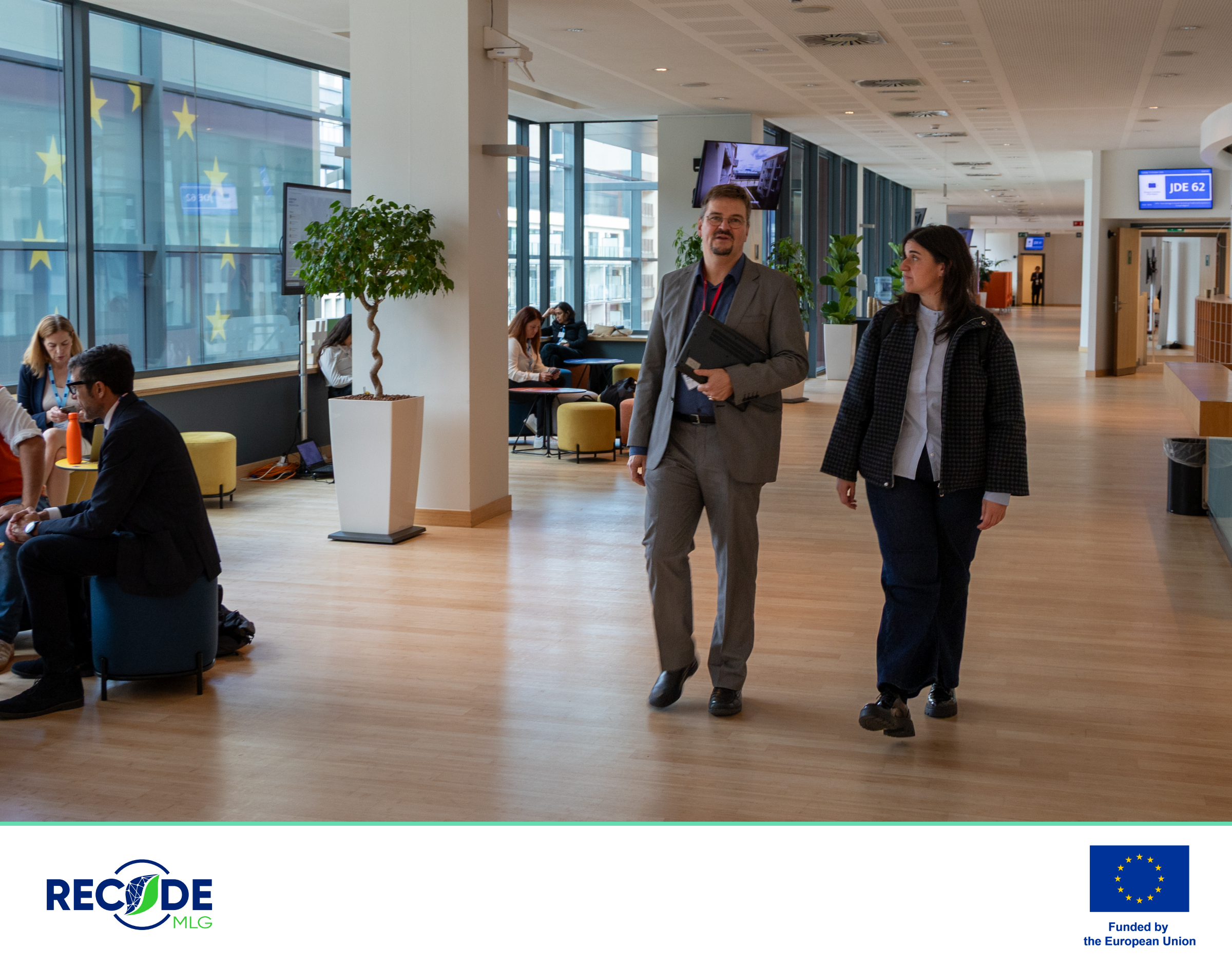
On 13 October 2026, RECODE’s Gloria Ziglioli and Denis Domazet met Schönlau to explore how local knowledge enters European policymaking. A political adviser to the PES Group in the European Committee of the Regions and a member of RECODE’s advisory board, he contributes to the project in his personal capacity.
The conversation brought RECODE’s interest in co-creation into contact with the everyday work of negotiating policy across institutions and levels of government. Three themes emerged: the timing of participation, the resources needed to contribute, and the relationship between influence and political responsibility.
Local knowledge needs an early route into decisions
Schönlau described the connection between European environmental policy and local responsibilities. Objectives for air quality, water quality and waste management become practical tasks involving services, infrastructure and public spending. Local and regional authorities encounter the consequences through the decisions they make and the communities they serve.
The European Committee of the Regions gives these authorities a formal advisory role in EU policymaking. Its members bring local and regional political experience into discussions on proposals that may affect their work at home.
For Schönlau, the timing of this contribution matters. The Committee seeks to bring local and regional concerns into proposals early, while amendments and adjustments remain possible. Once negotiations have advanced and compromises have been reached, securing a change becomes more difficult.
That also involves translating experience from a particular place into an argument others can act on. A municipality’s difficulty with a proposed requirement needs to be explained in terms that are relevant to the wider policy discussion.
Schönlau also pointed to the efforts to develop new formats of input for local and regional governments to EU policy making within the confines of the institutional role of the Committee of the Regions, such as the Green Deal Going Local working group, a cross-thematic and cross-party subset of CoR members who come together to exchange with other practitioners based on their first-hand experience in implementation of EU environmental policy.
Shared objectives meet different local investments
Waste management provided a concrete example. Schönlau described cities with investments in waste incineration linked to district heating, alongside cities that have invested further in reducing emissions from waste treatment.
Those choices create different expectations about future policy. More demanding environmental requirements can bring costs for authorities with existing infrastructure. Authorities that have already invested in cleaner treatment, meanwhile, may see weaker requirements as undermining the value of their investment.
The example illustrates how support for a common environmental objective can coexist with different views about the route towards it. Existing infrastructure, available resources and earlier decisions all influence the position an authority brings to the table.
Participation depends on time and support
The capacity to contribute also varies. Schönlau described representatives combining their European responsibilities with demanding political roles at home. Some have administrative teams and specialist knowledge available. Others work with limited support. Even well-resourced representatives may struggle to find time alongside urgent local responsibilities.
Language can create another barrier to sharing experience and following a policy process. These practical conditions affect the range of local knowledge that reaches European discussions.
For RECODE’s work on co-creation, this draws attention to how participation is organised and supported. The time required, the accessibility of information and the support available to participants affect their opportunities to contribute over time.
Influence and responsibility belong together
Ziglioli brought the discussion to the ambition of giving participants a meaningful role in shaping policy. She highlighted the challenge of involving people earlier in the policy process, where the choices guiding implementation are being made.
Schönlau connected this ambition with local and regional representatives’ wish to help shape policies they will later implement. He also emphasised the constraints of decisions involving several institutions and levels of government: actors have different powers and mandates, competing priorities need to be negotiated, and the outcome must be feasible and financeable.
The conversation therefore connected participation with responsibility for the final decision. Giving different perspectives a place in policy development requires attention to how proposals can be changed, how disagreements are resolved and who has the authority to act.
For RECODE, the exchange offers a perspective from institutional practice on co-creation in Europe’s green transition. It makes visible the work involved in connecting local knowledge with decision-making: creating opportunities to contribute early, supporting participation and linking those contributions to institutions with the power to respond.
Justus Schönlau contributes to RECODE’s advisory board in his personal capacity. This article does not represent an official position of the European Committee of the Regions or the PES Group.
Photo: Denis Domazet.
Funded by the European Union. Views and opinions expressed are those of the author(s) only and do not necessarily reflect those of the European Union. The European Union cannot be held responsible for them.

