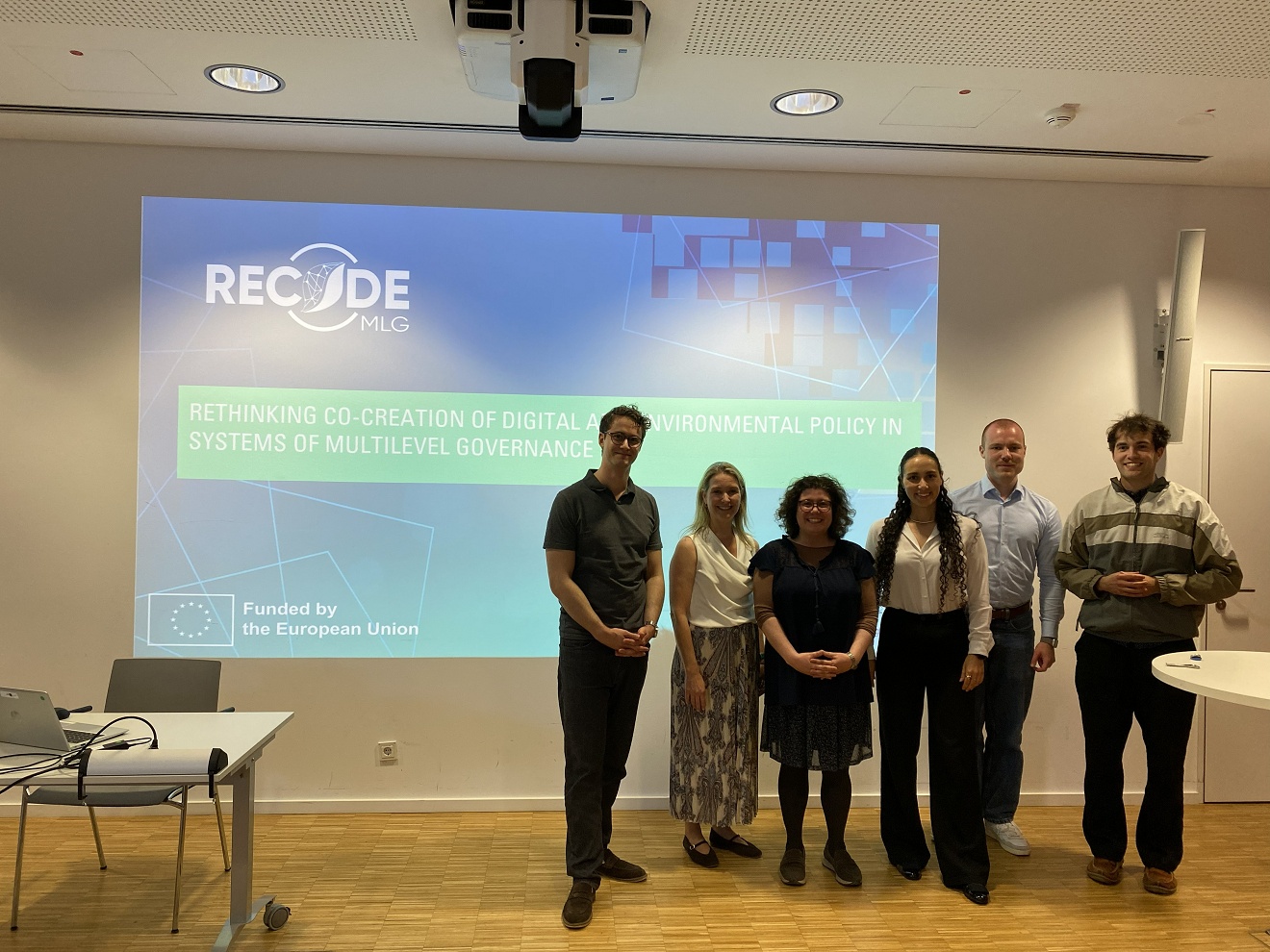
On 5 June 2026, researchers and practitioners gathered at the Marsilius Kolleg in Heidelberg to explore the role of subnational actors in driving the twin transition.
The programme opened with two thematically framing contributions. Katharina Müller introduced the RECODE project, outlining the considerable potential of the twin transition while also highlighting the tensions and implementation challenges that arise specifically at the regional and local level: the focus of Work Package 4 within RECODE. Prof. Dr. Jale Tosun then presented key findings from the book “Subnational Climate Leadership Dynamics Among Under2 Coalition Members”, co-authored with Simon Bulian, Alfie Gaffney, Joan Enguer, and Emiliano Levario Saad, with a particular focus on Baden-Württemberg’s role within transnational networks of regional alliances.
Thore Wann, Louis Hutters genannt Bohr, Prof. Dr. Melanie Nagel, and Alexander Helm followed with three presentations regarding distinct aspects of the subnational dynamics of the twin transition. One contribution explored whether Baden-Württemberg acts as a leader or follower in international climate policy, situating the German federal state within a broader comparative perspective. A second examined climate policy implementation at the municipal level, drawing on the case of Heidelberg. While the city demonstrates substantial capacities in agenda-setting and stakeholder mobilisation, fragmented administrative structures, a dominance of soft instruments, and a persistent gap between discourse and concrete policy output leave its climate neutrality targets out of reach. The third examined data centres as contested digital infrastructure, framing them as sites where three competing logics — digital sovereignty, climate and resource constraints, and local acceptance — collide. Drawing on the case of Maintal near Frankfurt in Germany, the presentation illustrated how the benefits of digital infrastructure tend to be distributed across regions while its material costs fall on specific localities, raising fundamental questions of multi-level governance and democratic legitimacy.
The afternoon closed with a panel discussion moderated by Prof. Dr. Jale Tosun. Bringing together researchers and local policymakers and administrators in the same room, this panel was particularly fruitful: while Prof. Dr. Melanie Nagel offered theoretical and comparative perspectives, Dr. Jan Gradel, Leander von Detten, and Sabine Lachenicht grounded the discussion in the realities of day-to-day municipal governance, including barriers to the green and digital transition that can be overlooked in research and policy debates, among them the severe budget constraints faced by municipalities, which can make it impossible to hire the additional staff needed to plan and implement climate measures, regardless of political will or ambition.
The discussion underlined a central challenge at the heart of the RECODE MLG project: the success of the twin transition depends not only on policy frameworks set at the European or national level, but on the capacities, resources, and governance structures of the cities and regions that must ultimately put them into practice.